Hat Tip Tyler Durden
With recent (post-Minutes) chatter of a gradually-tightening Fed since curtailed by a plethora of Federal Reserve market savants jawboning us back to creditopia - "the liquidity must flow"; we thought a gentle reminder of what Quantitative Easing really is was worthwhile. Whether goldbug, bond-vigilante, or permabull-stock-muppet; two-and-a-half minutes of reality (or comedy) depending on your perspective.
Showing posts with label Federal Reserve. Show all posts
Showing posts with label Federal Reserve. Show all posts
Saturday, February 23, 2013
Friday, March 2, 2012
Inflation Is A Tax And The Federal Reserve Is Taxing The Living Daylights Out Of Us
The Economic Collapse Blog
 Ronald Reagan once famously declared that inflation is a tax, but sadly most Americans did not really grasp what he was talking about. If the American people truly understood what inflation was doing to them, they would be screaming bloody murder about monetary policy. Inflation is an especially insidious tax because it is not just a tax on your income for one year. It is a continual tax on every single dollar that you own. As your money sits in the bank, it is constantly losing value. Over time, the effects of inflation can be absolutely devastating. For example, if you put 100 dollars in the bank in 1970, those same dollars today would only have about 17 percent of the purchasing power that they did back then. In essence, you were hit by an 83 percent "inflation tax" and all you did was leave your money in the bank. So who is responsible for this? Well, the Federal Reserve controls monetary policy in the United States, and the inflationary monetary policy that the Fed has gotten all of us accustomed to is taxing the living daylights out of us. This is madness, and it needs to stop.
Read More
Ronald Reagan once famously declared that inflation is a tax, but sadly most Americans did not really grasp what he was talking about. If the American people truly understood what inflation was doing to them, they would be screaming bloody murder about monetary policy. Inflation is an especially insidious tax because it is not just a tax on your income for one year. It is a continual tax on every single dollar that you own. As your money sits in the bank, it is constantly losing value. Over time, the effects of inflation can be absolutely devastating. For example, if you put 100 dollars in the bank in 1970, those same dollars today would only have about 17 percent of the purchasing power that they did back then. In essence, you were hit by an 83 percent "inflation tax" and all you did was leave your money in the bank. So who is responsible for this? Well, the Federal Reserve controls monetary policy in the United States, and the inflationary monetary policy that the Fed has gotten all of us accustomed to is taxing the living daylights out of us. This is madness, and it needs to stop.Read More
Sunday, December 25, 2011
The Economic Solutions Of Vampires

The vampire bat is a horrifying pig-nosed wart of a creature which feasts in a manner that, believe it or not, is a rather familiar scene to those of us who closely study alternative economics. After erratically flittering about in the sinking evening sky, it targets the warmth of a sleeping farm animal and latches onto it with its claws. Carefully, it inserts a fang into a vein dense region of the creature’s body, and laps away at the blood. Normally, the oblivious livestock are completely unaware and helpless to the attack. The tiny parasite does not inflict an immediately mortal blow to its host, but over time, disease and physical debilitation result. The vampire has destroyed the animal, and, pathetically, the animal has no idea.
Just as in nature, the economic world has its own bloodsucking vermin in the form of banking elites which are a wretched drain on the whole of the human race. Without their vicious and predatory presence, I envision a world so rapturously above and beyond what we wallow in today that it is impossible to describe. The disgust many feel when considering the virulent feeding habits of the common mosquito or the slithering leech does nothing to compare to the utter gut churning revulsion I feel when studying the financial habits of banks like the Federal Reserve and the “too big to fails”. They are without a doubt the most malignant form of social cancer imaginable.
And yet, after nearly four years of ongoing fiscal exsanguination, a sizable portion of the American populace is still looking to these pests for economic comfort and reassurance, just like farm animals consistently grazing near the entrance of a vampire bat cave, as if it is a shelter from harm. Worst of all is the willingness by which investors still, to this day, commit their savings and their livelihoods to the stock market meat grinder. Let’s be honest; the typical American daytrading investor is a complete moron. They have absolutely no sense of the fundamentals of our financial structure nor the eccentric rules by which it operates. They only have the faintest inkling of the functions of the highly manipulated stock market. They foolishly believe that what little money they make today riding the wave of an illegitimate liquidity driven rally they will actually get to keep. For them, stock investment is no different from buying a scratch-off lotto ticket at a hillbilly gas station; it is a cheap and tawdry game rife with failure but exciting to play, if only for a fleeting guilt addled thrill.
To be fair, they play because the game is indeed “rewarding”, at least, initially. The first taste is so sweet that it soils the plasma; the very skin of the cellular membrane of the financial mind becomes saturated. It swells within the weakening heart of a culture, and overrides its sense of logic. It makes us do terrible and stupid things, and we clasp our hands together and pray that it will never end. But, of course, an ending is painfully inevitable. The more we indulge, the more it takes down the road to satisfy us. We become an addict nation, riding the chemical wave of a pharmaceutical roller coaster fed by the opiates of fiat and fantasy.
The bottom line; we are being drained of our lifeblood as a country. However, the mainstream media is rife with talk of “recovery”, and one might ask how this could be possible. An overwhelming spectrum of solutions has been presented over the past 3-4 years, and each one has given the stock market a little push towards the green, so what’s the problem?
The problem is, the actions taken by our government and banking elites have built the connecting strands of a spider’s web, instead of a safety net.
Let’s examine some the most common solutions presented to the increasingly desperate American public and why these delusions have lulled us into the role of victim in the most elaborate monster movie of all time…
Centralization As a Solution To…Centralization…?
Europe’s current disintegration is a perfect example of this strange and ultimately destructive policy. The EU as an experiment is an utter disaster. Once the jewel of the open border dynamic and a bastion of the “merits” of globalization, the economic union has been exposed as a kind of waxwork museum; a tourist trap curiosity filled with illusions of life, but rather hollow upon closer inspection.
Half of the countries committed to the EU are burdened with liabilities well beyond the 60% debt to GDP ratio outlined in the ‘Growth and Stability Pact’. Some countries, including Greece, met few if any of the presented criteria for membership and were allowed to join anyway. The only reason the system was able to function at all was due to the imaginary wealth of the toxic derivative framework which now no longer exists.
The problem with globalization is that it requires assimilation; it demands that sovereign nations adopt the fiscal character of their neighbors in order to present the face of a single entity. Of course, when these countries are unable to do this because of their cultural differences, or their incongruent economies, something has to be slapped together instead. Artificially tying together societies by forcing them to financially harmonize is, in my view, a criminal act of collectivism. Now that this crime is being unveiled for all the world to see, though, the corrupt governments and banking puppeteers of Europe have suggested even MORE of the same! That’s right…their solution to the collapse of the EU is a harmonization not just of finance, but of politics and law. A single governing body which would dictate every nuance of the union.
The claim that Europe was not centralized enough, and that this is what caused the breakdown, is absolutely preposterous. Globalization makes a system inflexible and weak. If any portion of that system fails, it sends shockwaves through the rest. This is because centralization removes the protections of independently insulated structures and allows corrupt policy to spread like a plague. As the economic situation grows more dire, the end result will always be a reduction in the common citizen’s standard of living. In harmonization, It is far easier to make everyone equally poor than it is to make them equally rich. With a single, narrow minded leadership, especially one that is completely unaccountable to the people, the EU will become the most fragile makeshift empire in history, and a model for a global government that hopefully will never exist.
Print To Avoid The Pain…
I can’t tell you how truly exhausted I am with the constant rehashing of bailout bills and cheap lending windows as if they have ever or will ever change anything. Let’s make this clear; Keynesian stimulus measures are useless. They will always be useless. Governments do NOT create jobs, they destroy them. Central banks do NOT create wealth, they dilute it. Quantitative easing and zero interest lending does NOT diminish debt, it displaces it; removing it from the shoulders of private corporate banking institutions where it belongs and dumping it in the laps of taxpayers. I’ll say it again; the debts created by major banks have not been paid. They have been handed to you, and your children. Forget the December Santa Rally and the temporary holiday job boost. Nothing has changed since 2008.
The process of transferring private debt into public obligation is a tool of economic vampires. The utility in this is obvious. A program of wealth transference has the ability to prolong full collapse while at the same time giving the impression of stability. The dollar itself characterizes this conflict. The currency has been overprinted since the credit crisis began by some estimates in the ten’s of trillions. Not only has it been devalued to temporarily stave off a purging in the U.S., but now also in Europe. And yet, the dollar index, which supposedly measures the Greenback’s global value, has spiked. We are lulled into a sense of safety by such arbitrary measurements, but our buying power is being subversively annihilated. In less than a year’s time, those who dove into the dollar as a safe haven will discover their bones picked clean by predatory banks and hidden flesh eating inflation. Count on it…
Create A New Currency…
Globalists love currencies, as long as they aren’t tied down by a commodity. For central bankers, each fiat currency is a stepping stone to something more sinister. They are disposable. They are expendable. Like toothbrushes. Yes…even the dollar. And in this rests the key to economic control. A currency is a symbol of trade and labor; if you can create and destroy that symbol at will, then you can dominate trade and labor. Through a mere piece of paper, you manipulate the very breath of social life. No one should be given that kind of power without uncompromising transparency and constant public governance, but the Federal Reserve is free from both.
The suggestion that we can solve our current financial despair with the formation of a whole new currency, or a global currency, is like suggesting to a slave that he would be much more free with a shinier set of chains. Any solution that purports to undo the crisis by doing more of the same was probably devised by an economic vampire.
This includes digital currencies like the failed “Bitcoin”, which swagger about in the classy looking threads of technology and diversity while flashing us impromptu peace signs. Digital currencies are a Star Trek theme park distraction, and just like any paper fiat currency, they make promises they cannot keep. Any trade system that depends upon good faith in ones and zeros traveling across a network of machines that can be hacked or rendered useless by collapse is doomed. We have already tasted the danger of digital through the debauchery of credit cards. Why tempt fate even further?
More Regulation And Control…
Regulation is not the problem in America’s economy; the REGULATORS are the problem with America’s economy. The SEC is given thousands of potential investigations a year to pursue, but rarely do they ever follow through, and when they do, it’s to throw the angry masses a Bernie Madoff or two; an act of insincere appeasement in light of much greater fraud.
Being that true free markets have not existed for at least a century, the insinuation that free markets are the root of the collapse is a bit absurd. The guidelines for government oversight of business in the U.S. already exist; government has just refused to implement them. Adding new restrictions to an already restricted market will change nothing. Therefore, the only solution that makes any sense whatsoever as far as regulation is to wipe the slate clean entirely. Remove the Federal Reserve, replace the SEC, and replace the current establishment leadership.
I have heard it said that the philosophy of our economic system is the problem. This is an ignorant cop-out. The principals of free markets are not the issue; the men who abuse them and diminish them, on the other hand, are. Anyone who suggests that we as a country should focus our anger on the idea of the system rather than the men behind the misuse of that system is, without a doubt, an economic vampire.
Lurking in the Shadows...
The question of solutions is difficult, not because there aren’t any, but because those that will actually succeed require pain, sacrifice, and incredible hard work. Most people don’t like to think about that sort of thing. This is why global banks and their proponents have been able to maintain the recovery magic act for the past few years (just barely), and it is why the useless concepts they put forward are still given public consideration. We WANT to be sold on the proposal of an easy way out.
One rule to never forget when considering any solution is to take into account who benefits most from its implementation, and who has to labor for its success. If average people are forced to exert all the effort, and an elite few reap all the substantial benefits, this contradiction outweighs any assertion of practicality. It is not worth our time, nor our energy, to shadowbox reality. Unfortunately, this is all we have been doing as a nation since 2008.
The creeping terror that lay ahead is not the economic collapse, but the men who would use it to their favor. The stakes are high. With the NDAA and similar bills in place, fiscal distress is no longer just a matter of economics, but a matter of personal liberty. Without a doubt, a collapse will be used as a rationalization for totalitarianism. If we do not make the hard decisions now, and take it upon ourselves to construct our own localized economies separate and insulated from the mainstream, we will, indeed, find ourselves one day cowering in the dark of a long drawn night infested with fiends, and desperate enough to actually ask them for help. They will be happy to give it, at a very bloody price…
Friday, December 16, 2011

Thursday, December 15, 2011
Sunday, December 4, 2011
Money, Banking and the Federal Reserve
Thomas Jefferson and Andrew Jackson understood "The Monster" a.k.a The Octopus. But to most Americans today, Federal Reserve is just a name on the dollar bill. They have no idea of what the central bank does to the economy, or to their own economic lives; of how and why it was founded and operates; or of the sound money and banking that could end the statism, inflation, and business cycles that the Fed generates.
Dedicated to Murray N. Rothbard, steeped in American history and Austrian economics, and featuring Ron Paul, Joseph Salerno, Hans Hoppe, and Lew Rockwell, this extraordinary new film is the clearest, most compelling explanation ever offered of the Fed, and why curbing it must be our first priority.
Alan Greenspan is not, we're told, happy about this 42-minute blockbuster. Watch it, and you'll understand why. This is economics and history as they are meant to be: fascinating, informative, and motivating.
Dedicated to Murray N. Rothbard, steeped in American history and Austrian economics, and featuring Ron Paul, Joseph Salerno, Hans Hoppe, and Lew Rockwell, this extraordinary new film is the clearest, most compelling explanation ever offered of the Fed, and why curbing it must be our first priority.
Alan Greenspan is not, we're told, happy about this 42-minute blockbuster. Watch it, and you'll understand why. This is economics and history as they are meant to be: fascinating, informative, and motivating.
This movie could change America
Saturday, October 8, 2011
Occupy the Fed.
Audrey: "Opportunity for Texas ppl to come out and protest against the Federal Reserve."
Public sentiment has shifted-- against the trends of Washington and Wall Street-- and now, against the private Federal Reserve bank which controls or influences so much of the world's finances. Where as only a few years ago many Americans were unaware of the true nature of the shadowy organization, recent polls confirm that the public overwhelmingly wants to audit and even abolish the Federal Reserve bank.
The momentum for a second American revolution is stirring, but the establishment is working overtime to steer the public's anger into easy controlled avenues and big government solutions. Instead, by striking at the root of the true problems, we can attempt to reign in the predatory banking powers that plague our nation and begin to restore the Republic.
The Federal Reserve banking system is at the root of that problem and a perpetual impediment towards ending the global economic crisis that continues to grow. Join Alex Jones to "occupy" the Dallas Federal Reserve, or take the message to a Fed branch near you. We must start now by focusing media and political attention on this issue, and through our presence at these banks, start brushfires in the minds of men that will tip the momentum in favor of liberty and independence for all.
The momentum for a second American revolution is stirring, but the establishment is working overtime to steer the public's anger into easy controlled avenues and big government solutions. Instead, by striking at the root of the true problems, we can attempt to reign in the predatory banking powers that plague our nation and begin to restore the Republic.
The Federal Reserve banking system is at the root of that problem and a perpetual impediment towards ending the global economic crisis that continues to grow. Join Alex Jones to "occupy" the Dallas Federal Reserve, or take the message to a Fed branch near you. We must start now by focusing media and political attention on this issue, and through our presence at these banks, start brushfires in the minds of men that will tip the momentum in favor of liberty and independence for all.
Thursday, September 22, 2011
Barton Biggs of Traxis Partners LP ... biggest two-day plunge in U.S. stocks since 2008
 |
| http://j.mp/mSNQtf |
Peter Schiff on CNBC Halftime Report Sept. 22, 2011
h/t alternativenewsreport.net
Global Meltdown: Investors Are Dumping Nearly Everything
CNBC's Sue Herera & Tyler Mathisen discuss How Low Can Financial Markets Go?
Wednesday, September 21, 2011
alternativenewsreport.net - "Reading Between the Lines In Media News Reports" via @altnewsforum
I just had an interesting experience watching this short video clip below about "FED transparency." Listen carefully to the dialogue and listen carefully to the questions that are being asked by the reporters in this clip. What does FED transparency in the USA have to do with a "coordinated central bank policy around the world?" Nothing. At 2 minutes and 13 seconds into this video the second reporter, a woman, is asking a leading question which is NWO scripted.Copyright 2011-3011 Chase Kyla Hunter & Alternative News Report, All Rights Reserved.Read the Whole Article
Sunday, July 24, 2011
The Economic Shell Game
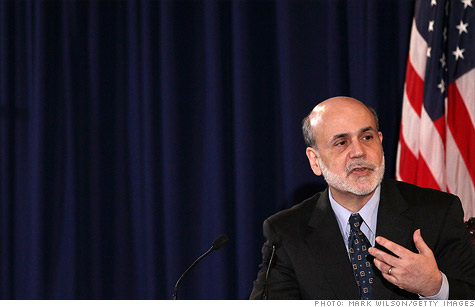 Fed Chairman Ben Bernanke isn't done buying Treasuries, even if QE2 is almost over.
Michael T. Snyder seekingalpha.com
The entire U.S. financial system has become a gigantic shell game. While it is still in motion, a shell game can be mesmerizing to watch. But when it ends the consequences can be painful. So exactly what is a shell game? According to Wikipedia, a shell game "is portrayed as a gambling game, but in reality, when a wager for money is made, it is a confidence trick used to perpetrate fraud." Sadly, that is exactly what is happening on the global stage today.
The Federal Reserve is like a con artist that is desperately trying to stay one step ahead of everyone else. The folks at the Fed know that the debt that the U.S. government has accumulated is not sustainable and will eventually collapse. They also know that the U.S. dollar is eventually going to become essentially worthless. But for now, the Federal Reserve is putting on a grand show and is trying to keep everyone believing that the game is fair and legitimate.
The Federal Reserve's much ballyhooed "QE2" program has come to an end, and most Americans still don't even understand what "quantitative easing" is. Basically, what the Federal Reserve did was zap hundreds of billions of dollars into existence out of thin air and used them to buy U.S. government debt. It is kind of like if you are playing poker with someone and they reach under the table and pull out a gigantic pile of chips which they add to their own stack.
In the process, the big banks made a ton of money because they are the ones that the Federal Reserve was buying U.S. Treasuries from and the U.S. government was happy because all of the new government debt being issued was getting soaked up by the system.
Of course, all of this is one giant Ponzi scheme, but up to this point the Federal Reserve has gotten away with it. Meanwhile, average Americans were getting the short end of the stick because all of this new money has been causing the price of food and the price of gas to go up.
But now QE2 has come to an end. So does that mean that "quantitative easing" is going to be completely over? No, not really. The shell game continues.
The Federal Reserve has announced that it is going to continue to purchase U.S. government debt using the proceeds from maturing debt that it already owns. It is being projected that the Federal Reserve will purchase $300 billion in U.S. government debt over the next 12 months using this method.
This isn't being called "quantitative easing," but that is essentially what it is. In fact, one CNN article is calling it "QE2.5":
But quantitative easing is just one example of a shell game run by the Fed. There have been lots more. For example, during the financial crisis, the Federal Reserve started loaning gigantic amounts of cash to the big banks for next to nothing. The big banks took a lot of this cash and invested it in U.S. Treasuries. U.S. Treasuries typically only pay a couple of percentage points, but when you can borrow massive amounts of nearly free money suddenly they become extremely profitable.
Instead of loaning out large amounts of money to all of us to get the economy rolling again, the big banks just parked huge amounts of cash in U.S. Treasuries and watched the risk-free profits come rolling in. In this way, the Federal Reserve helped big banks make a ton of money and they supported the exploding federal government debt load at the same time.
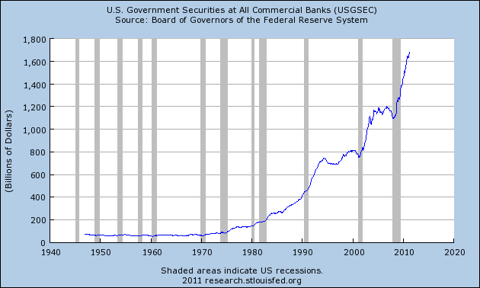
The chart below shows that the amount of U.S. government securities owned by the banks has increased exponentially since the beginning of the financial crisis. This is not an accident.
The Federal Reserve does lots of stuff like this. It knows that it will probably never get audited, and it knows that the American people don't understand all of this financial stuff, so it gets away with it.
But what if something came along and suddenly interrupted the shell games that the Fed is playing? Well, that is exactly what this debt ceiling debate threatens to do. If the U.S. defaults, even for a short time, all of the financial shell games and Ponzi schemes are going to be greatly jeopardized.
If Congress does not raise the debt ceiling by August 2, the U.S. government will start defaulting, and that would unleash a tremendous amount of chaos. A recent USA Today article described some of the things that might happen if the government was not able to borrow any more money later this summer:
If Social Security, Medicare, Medicaid, unemployment benefits, payments to defense contractors and interest payments on Treasury bonds were exempt, that would be all the government could afford for the month. No money for troops or veterans. No tax refunds. No food stamps or welfare. No federal salaries or benefits.
In addition, financial markets all over the world would be severely rattled. If the default only lasted a couple of days it would not be bad, but if the U.S. ended up defaulting on debts for weeks or months it really would be cataclysmic.
The International Monetary Fund warned this week that a failure to raise the debt ceiling by August 2 would be a "severe shock" to global financial markets. In this case, the IMF is actually right. In fact, a "severe shock" would be an understatement.
The managing director of Standard & Poor's has told Reuters that if the U.S. starts defaulting, the credit rating on U.S. Treasury bonds that are supposed to mature on August 4 will go all the way down from AAA to D:
A lot of Americans believe that Congress should just refuse to raise the debt ceiling and let the whole system crash. But the reality is that most Americans simply have no idea how much of a financial disaster that would be for the entire globe.
Yes, the U.S. national debt is completely and totally out of control. Yes, something must be done about it urgently. But defaulting on our debts and wrecking global financial markets is not going to solve much of anything. Sadly, even if we do not default on our debts this year, the reality is that the U.S. government debt bubble is going to collapse one way or another eventually.
The path that we are currently on is not even close to sustainable. Even as our debt expands exponentially, the U.S. economy is being systematically dismantled and we are becoming poorer as a nation. As I have written about previously, jobs and businesses are leaving the United States at a staggering rate because of cheap labor overseas and because of ridiculous regulations. The business environment in this country has become incredibly toxic.
Stanford University’s David Cheriton was instrumental in helping Sergey Brin and Larry Brin develop Google (GOOG). Now he is warning that the anti-business policies of Barack Obama and the U.S. Congress are wrecking the economy:
As I wrote about the other day, the rate of new business creation in the United States has been declining steadily since the 1980s. We won't have a chance at a real economic recovery until the creation of small businesses is encouraged once again.
But today businesses of all sizes are trying to avoid U.S. taxation. Right now, the United States has the highest corporate tax rate in the entire world. Sadly, all businesses have a great deal of incentive to avoid incorporating in the United States.
A recent article in The Wall Street Journal talked about this phenomenon:
Large numbers of really good companies are fleeing the United States. What we are doing is not working.
So what is the answer? As I have said before, we need to entirely scrap the current tax system and come up with something that works in the 21st century. But we all know that is not going to happen.
Meanwhile, our economy continues to unravel. According to the Department of Labor, the unemployment rate rose in 210 metro areas during the month of May, and it only declined in 131 metro areas.
Consumer confidence in this country has hit a seven-month low, and average Americans are becoming increasingly anxious about the state of the economy. Unfortunately, most of our politicians don't seem to have any answers and the Federal Reserve is just trying to keep their shell games going.
Every single day the U.S. economy is getting weaker. Every single day we are going into more debt. Every single day we get closer to the collapse of the entire system. Time is running out. I hope you are making good use of the time you still have left.
http://seekingalpha.com/article/277413-the-economic-shell-game
The Federal Reserve is like a con artist that is desperately trying to stay one step ahead of everyone else. The folks at the Fed know that the debt that the U.S. government has accumulated is not sustainable and will eventually collapse. They also know that the U.S. dollar is eventually going to become essentially worthless. But for now, the Federal Reserve is putting on a grand show and is trying to keep everyone believing that the game is fair and legitimate.
The Federal Reserve's much ballyhooed "QE2" program has come to an end, and most Americans still don't even understand what "quantitative easing" is. Basically, what the Federal Reserve did was zap hundreds of billions of dollars into existence out of thin air and used them to buy U.S. government debt. It is kind of like if you are playing poker with someone and they reach under the table and pull out a gigantic pile of chips which they add to their own stack.
In the process, the big banks made a ton of money because they are the ones that the Federal Reserve was buying U.S. Treasuries from and the U.S. government was happy because all of the new government debt being issued was getting soaked up by the system.
Of course, all of this is one giant Ponzi scheme, but up to this point the Federal Reserve has gotten away with it. Meanwhile, average Americans were getting the short end of the stick because all of this new money has been causing the price of food and the price of gas to go up.
But now QE2 has come to an end. So does that mean that "quantitative easing" is going to be completely over? No, not really. The shell game continues.
The Federal Reserve has announced that it is going to continue to purchase U.S. government debt using the proceeds from maturing debt that it already owns. It is being projected that the Federal Reserve will purchase $300 billion in U.S. government debt over the next 12 months using this method.
This isn't being called "quantitative easing," but that is essentially what it is. In fact, one CNN article is calling it "QE2.5":
QE2 is just about done. But the Federal Reserve will still be buying massive amounts of long-term Treasuries.
In fact, the Fed's purchases over the next year will likely be at least $300 billion. That's half the size of QE2 -- even if QE3 never takes place.
But quantitative easing is just one example of a shell game run by the Fed. There have been lots more. For example, during the financial crisis, the Federal Reserve started loaning gigantic amounts of cash to the big banks for next to nothing. The big banks took a lot of this cash and invested it in U.S. Treasuries. U.S. Treasuries typically only pay a couple of percentage points, but when you can borrow massive amounts of nearly free money suddenly they become extremely profitable.
Instead of loaning out large amounts of money to all of us to get the economy rolling again, the big banks just parked huge amounts of cash in U.S. Treasuries and watched the risk-free profits come rolling in. In this way, the Federal Reserve helped big banks make a ton of money and they supported the exploding federal government debt load at the same time.
The chart below shows that the amount of U.S. government securities owned by the banks has increased exponentially since the beginning of the financial crisis. This is not an accident.
The Federal Reserve does lots of stuff like this. It knows that it will probably never get audited, and it knows that the American people don't understand all of this financial stuff, so it gets away with it.
But what if something came along and suddenly interrupted the shell games that the Fed is playing? Well, that is exactly what this debt ceiling debate threatens to do. If the U.S. defaults, even for a short time, all of the financial shell games and Ponzi schemes are going to be greatly jeopardized.
If Congress does not raise the debt ceiling by August 2, the U.S. government will start defaulting, and that would unleash a tremendous amount of chaos. A recent USA Today article described some of the things that might happen if the government was not able to borrow any more money later this summer:
If Social Security, Medicare, Medicaid, unemployment benefits, payments to defense contractors and interest payments on Treasury bonds were exempt, that would be all the government could afford for the month. No money for troops or veterans. No tax refunds. No food stamps or welfare. No federal salaries or benefits.
In addition, financial markets all over the world would be severely rattled. If the default only lasted a couple of days it would not be bad, but if the U.S. ended up defaulting on debts for weeks or months it really would be cataclysmic.
The International Monetary Fund warned this week that a failure to raise the debt ceiling by August 2 would be a "severe shock" to global financial markets. In this case, the IMF is actually right. In fact, a "severe shock" would be an understatement.
The managing director of Standard & Poor's has told Reuters that if the U.S. starts defaulting, the credit rating on U.S. Treasury bonds that are supposed to mature on August 4 will go all the way down from AAA to D:
Chambers, who is also the chairman of S&P's sovereign ratings committee, told Reuters on Tuesday that U.S. Treasury bills maturing on August 4 would be rated 'D' if the government fails to honor them. Unaffected Treasuries would be downgraded as well, but not as sharply, he said.
"If the U.S. government misses a payment, it goes to D," Chambers said. "That would happen right after August 4, when the bills mature, because they don't have a grace period."
A lot of Americans believe that Congress should just refuse to raise the debt ceiling and let the whole system crash. But the reality is that most Americans simply have no idea how much of a financial disaster that would be for the entire globe.
Yes, the U.S. national debt is completely and totally out of control. Yes, something must be done about it urgently. But defaulting on our debts and wrecking global financial markets is not going to solve much of anything. Sadly, even if we do not default on our debts this year, the reality is that the U.S. government debt bubble is going to collapse one way or another eventually.
The path that we are currently on is not even close to sustainable. Even as our debt expands exponentially, the U.S. economy is being systematically dismantled and we are becoming poorer as a nation. As I have written about previously, jobs and businesses are leaving the United States at a staggering rate because of cheap labor overseas and because of ridiculous regulations. The business environment in this country has become incredibly toxic.
Stanford University’s David Cheriton was instrumental in helping Sergey Brin and Larry Brin develop Google (GOOG). Now he is warning that the anti-business policies of Barack Obama and the U.S. Congress are wrecking the economy:
When you look at, say, Larry and Sergey of Google, they made billions of dollars, but they contributed many more billions of dollars to the US economy. And so we should be empowering these people; we should be cultivating more of the next generation of those types. And yet, I think there’s almost a hostile attitude towards people who have been successful in this country.
As I wrote about the other day, the rate of new business creation in the United States has been declining steadily since the 1980s. We won't have a chance at a real economic recovery until the creation of small businesses is encouraged once again.
But today businesses of all sizes are trying to avoid U.S. taxation. Right now, the United States has the highest corporate tax rate in the entire world. Sadly, all businesses have a great deal of incentive to avoid incorporating in the United States.
A recent article in The Wall Street Journal talked about this phenomenon:
As savvy investors and entrepreneurs search for ways to minimize the impact of the U.S. tax system, with its relatively high rates and global reach, they are increasingly incorporating overseas, tax experts say. Some private-equity firms have relocated U.S. companies or divisions to tax-haven countries. U.S. multinational companies have spun off foreign subsidiaries in tax havens. U.S. start-ups are even beginning life offshore.
Large numbers of really good companies are fleeing the United States. What we are doing is not working.
So what is the answer? As I have said before, we need to entirely scrap the current tax system and come up with something that works in the 21st century. But we all know that is not going to happen.
Meanwhile, our economy continues to unravel. According to the Department of Labor, the unemployment rate rose in 210 metro areas during the month of May, and it only declined in 131 metro areas.
Consumer confidence in this country has hit a seven-month low, and average Americans are becoming increasingly anxious about the state of the economy. Unfortunately, most of our politicians don't seem to have any answers and the Federal Reserve is just trying to keep their shell games going.
Every single day the U.S. economy is getting weaker. Every single day we are going into more debt. Every single day we get closer to the collapse of the entire system. Time is running out. I hope you are making good use of the time you still have left.
http://seekingalpha.com/article/277413-the-economic-shell-game
Friday, December 17, 2010
Feds Force Okla. Bank To Remove Crosses, Bible Verse
POSTED: 2:21 pm CST December 16, 2010
UPDATED: 10:18 am CST December 17, 2010
http://www.koco.com

Federal Examiners Say Religious Decoration Inappropriate
also Posted Here:
Worship Bernanke, Not God
Posted by Lew Rockwell on December 17, 2010 10:43 AM
The Fed orders a small Oklahoma bank to ditch crosses, Bible verses, and Merry Christmas buttons. (Thanks to Norm)
UPDATED: 10:18 am CST December 17, 2010
http://www.koco.com
Federal Examiners Say Religious Decoration Inappropriate
also Posted Here:
Worship Bernanke, Not God
Posted by Lew Rockwell on December 17, 2010 10:43 AM
The Fed orders a small Oklahoma bank to ditch crosses, Bible verses, and Merry Christmas buttons. (Thanks to Norm)
Thursday, October 28, 2010
Is The Federal Reserve Out Of Control?
By Michael Snyder - BLN Contributing Writer
What in the world is going on over at the Federal Reserve? Has it gotten to the point where the Federal Reserve is completely and totally out of control? There is increasing speculation in the financial community that the Federal Reserve is on the verge of unleashing another round of quantitative easing. In fact, at their September meeting, Federal Reserve officials hinted very strongly that quantitative easing is very much on their minds when they stated that the Federal Open Market Committee "is prepared to provide additional accommodation if needed to support the economic recovery and to return inflation, over time, to levels consistent with its mandate."
Read The Rest
What in the world is going on over at the Federal Reserve? Has it gotten to the point where the Federal Reserve is completely and totally out of control? There is increasing speculation in the financial community that the Federal Reserve is on the verge of unleashing another round of quantitative easing. In fact, at their September meeting, Federal Reserve officials hinted very strongly that quantitative easing is very much on their minds when they stated that the Federal Open Market Committee "is prepared to provide additional accommodation if needed to support the economic recovery and to return inflation, over time, to levels consistent with its mandate."
Read The Rest
Monday, September 13, 2010
Bernanke: Lehman’s Failure a Fait Accompli
The Hindenburg Omen Inventor has exited from Stocks:
Liz Moyer from Forbes Uptick
The trends had to be reconfirmed, and they were last week.
Plus, she has some other things to say about Federal Reserve Chairman Ben Bernanke, the Financial Crisis, and the Financial Crisis Inquiry Commission from this past Thursday.
Read The Rest
Liz Moyer from Forbes Uptick
The Hindenburg Omen, named after the airship that exploded as it was docking in New Jersey in 1937, has preceded every crash since 1987, but it has also popped up plenty of times without any subsequent market decline. It resurfaced in mid-August and became popular fodder for various trading oriented blogs. It was triggered by two important statistical events. One, NYSE highs and lows both exceeded 2.5% — stocks reaching 52-week highs were 2.9% of stocks traded at the Big Board, while stocks hitting 52-week lows were 2.6%. And two, a rising 10-week moving average for the NYSE compared to a negative indicator that shows market fluctuations (the McClellan Oscillator).
The trends had to be reconfirmed, and they were last week.
Plus, she has some other things to say about Federal Reserve Chairman Ben Bernanke, the Financial Crisis, and the Financial Crisis Inquiry Commission from this past Thursday.
So which is it, now? Did the Federal Reserve watch helplessly as Lehman failed because, as its officials have repeatedly asserted, they had no legal authority to stop it? Or had they already made up their minds that any intervention was useless? Seems like a little of both.
Read The Rest
Subscribe to:
Posts (Atom)